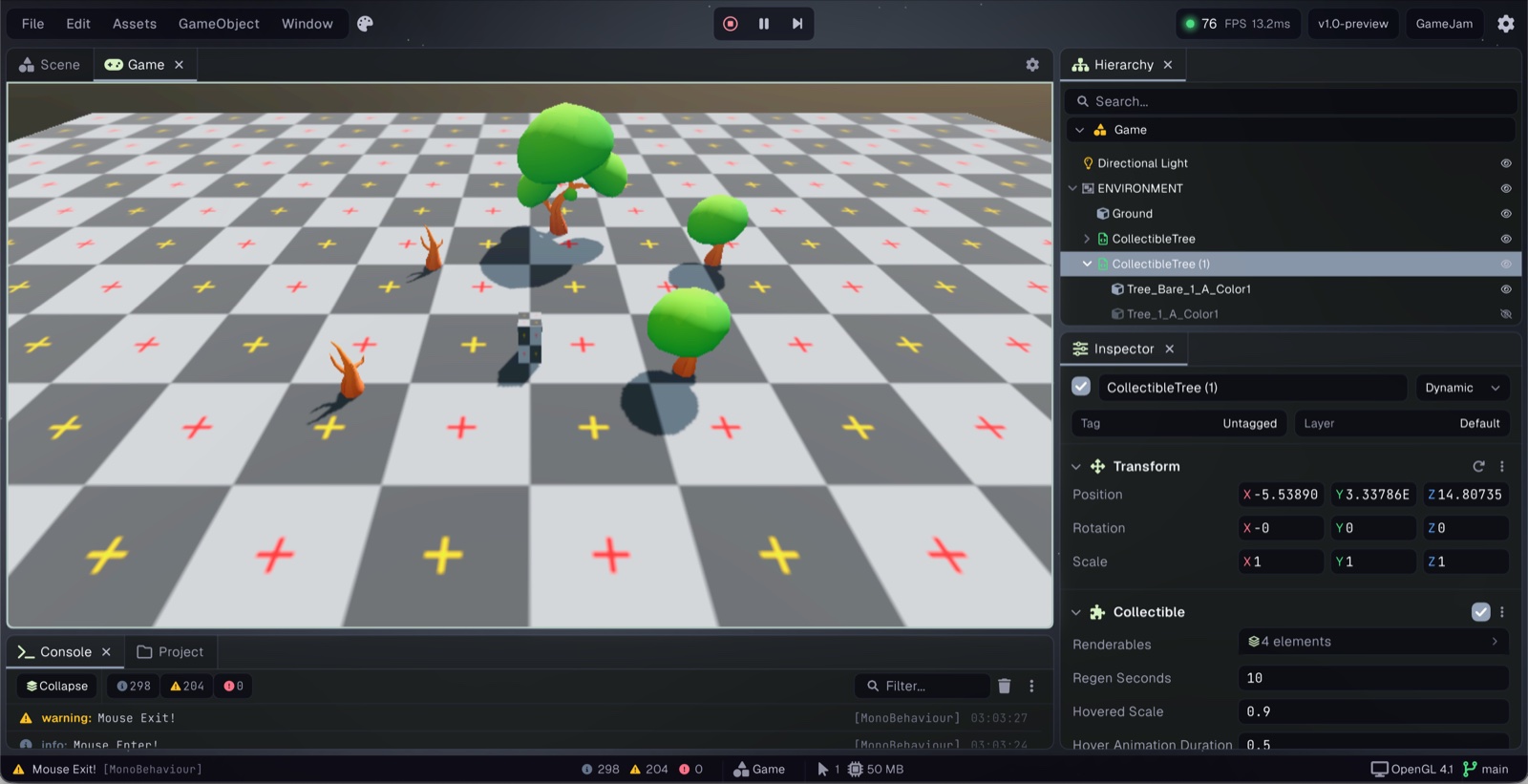
A fully featured 3D game engine, PBR rendering, shader graph, terrain, physics, audio, and a complete editor. MIT licensed, no royalties, full source access. Ready for your next project today.

The C# Difference
Most engines split you in two: the engine lives in C++ and your scripts live somewhere else, separated by a binding layer with overhead, friction, and a wall you can't see past. Prowl removes that wall entirely. Engine code and game code are the same language, the same binary, and equally readable.
No FFI overhead
Your game code calls engine code directly. No marshaling, no native interop layer, no serialization round-trip. It's all one IL binary.
The engine is readable
Every system, renderer, physics, audio, ECS, is plain C# you can open, read, and change. KISS principles throughout. No black boxes.
Scripts are first-class
Components you write have exactly the same capabilities as built-in engine components. There is no privileged internal API, only public C#.
Tooling just works
Prowl projects are standard .NET .csproj files. Rider, VS Code, and Visual Studio open and debug them
as-is, no plugin, no special extension, no ceremony.
using Prowl.Runtime; // Your component. Engine component. Same thing. public class PlayerController : MonoBehaviour { public float speed = 5f; private RigidBody3D rb; void Start() { // No reflection magic, direct reference rb = GetComponent<RigidBody3D>(); } void FixedUpdate() { var input = Input.GetAxis("Horizontal"); rb.AddForce(Vector3.right * input * speed); } }
The Prowl Ecosystem
Prowl isn't a monolith. Every subsystem is its own standalone, MIT-licensed C# library, usable independently, replaceable, and readable. The engine is the assembly.
Every box is a standalone, MIT-licensed C# repo under github.com/ProwlEngine
Standalone Libraries
Each library in the Prowl ecosystem is independently useful. Pull just the one you need, none of them require the engine to run.
A powerful immediate-mode .NET UI library, the same one powering the Prowl editor. Retained-mode results, immediate-mode ergonomics.
UIHardware-accelerated, anti-aliased 2D vector graphics in .NET. Curves, fills, strokes, GPU-driven, no software fallback.
GraphicsA lightweight, flexible .NET serializer with support for complex object graphs, circular references, and custom type handling.
SerializationA C# wrapper around the Slang shader compiler, cross-compile shaders to SPIRV, HLSL, GLSL, and Metal from a single source.
ShadersAn MIT-licensed .NET TTF parser and rasterizer. Load, shape, and render TrueType fonts without any native dependencies.
TypographyA 64-bit 3D mathematics library with a Unity-inspired API. Vectors, quaternions, matrices, all in double precision.
MathA render-pipeline-based graphics abstraction layer. Define render passes declaratively and run them across Vulkan, Metal, and DX12.
RenderingA pure .NET 2D physics library. Rigid bodies, collision shapes, constraints, no native binaries, no platform complications.
PhysicsA fast, low-level .NET networking transport layer. The foundation for Prowl.Wicked, the high-level game networking framework.
NetworkingEverything is open. Clone the repo, read the source, file an issue, open a PR. There are no gatekeepers, just the code and the people writing it.
Core Engine
Runtime + Editor
Full editor running. PBR, terrain, particles, physics, audio, all functional today.
Scripting
C# 14 .NET 10
Native C# components. No separate runtime. Full .NET access in scripts.
License
MIT
Engine, editor, and all Prowl.* libraries. No royalties, no strings.
What's included
Prowl ships with everything you'd expect from a production engine.
Rendering
Post Processing
Editor
Physics & Audio
World Building
Platform & Build